
Suicide Prevention, Intervention and Postvention

Talking About Suicide
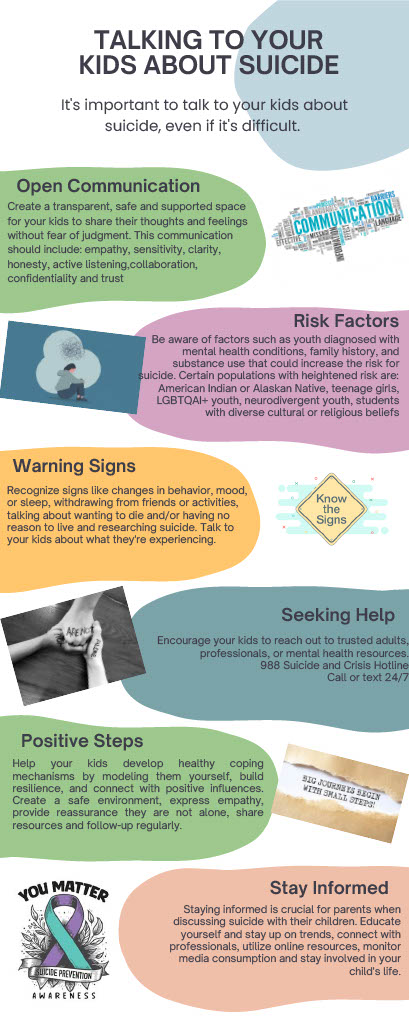
It's important to know how to #StartTheConversation. Talking about suicide with a friend or family member who is in emotional distress can be challenging, but it’s a significant step in offering support.
Here are some best practices for initiating the conversation:
✔️ Choose an Appropriate Setting
Find a private and comfortable place where your friend or family member feels safe talking. Ensure there are minimal distractions so you can give them your full attention.
✔️ Express Concern and Care
Begin by expressing your concern and care for them. Use “I” statements to avoid sounding accusatory, such as “I’ve noticed you’ve been feeling really down lately, and I’m worried about you.”
✔️ Ask Directly About Suicide
Be direct but compassionate. Asking about suicide does not plant the idea in someone’s head. Use clear language, such as, “Are you thinking about suicide? Or “With all the pain you’re feeling, have you thought about ending your life?”
✔️ Listen Non-judgmentally
Let them talk and express their feelings without interrupting or judging. It’s important to show empathy and understanding.
✔️ Validate their Feelings
Use phrases like, “I’m sorry you’ve been feeling this way” or “I’m here for you” to help show you care and make the person feel understood.
✔️ Encourage Professional Help
Suggest seeking help from a mental health professional and offer to help them find resources or go with them to an appointment. You can say, “Would you be willing to talk to a therapist or counselor? I can help you find one.” If they need more urgent support, you might say, “I think it’s important we get you some help right now. Would you like me to call 988 or go with you to the nearest psychiatric ER?"
✔️ Stay With Them
If they are in immediate danger, do not leave them alone. Remove any means they could use to harm themselves or contact 911 if necessary.
🎗️ Remember, suicide is preventable! Although it can feel uncomfortable, asking someone directly about suicide gives the person an opportunity to share their thoughts and feelings, which can be a big relief.
Prevention Programs in the Boise School District
Research indicates that prevention is much more than any program. In fact, prevention begins the moment a student walks through the door of their school. Every school has a unique culture of connection and belongingness that they strive to create with their students, famililes and the surrounding community. These connections help bond the students to their peers, teachers, and staff. Beyond this, Suicide Prevention is addressed in a variety of ways. In the Boise School District, this is primarily seen as a mental health and suicide prevention lessons that start in the elementary schools with Sources of Strength, and transition to discussions in Health classes and with Signs of Suicide in the secondary schools.
Below you will find three of the prevention programs currently being used in schools within the Boise School District. Hope Squad and Signs of Suicide are being used by all junior high and high schools, while Sources of Strength is used in all elementary schools.

Sources of Strength is a radically strength-based, upstream suicide prevention program with shown effectiveness in both preventative upstream and intervention outcomes.

SOS is an evidence-based youth suicide prevention program that has demonstrated an improvement in students’ knowledge and adaptive attitudes about suicide risk and depression.
Designed for grades 6-12, SOS teaches students how to identify signs of depression and suicide in themselves and their peers, while providing materials that support school professionals, parents, and communities in recognizing at-risk students and taking appropriate action.

Hope Squad's peer-to-peer approach empowers members to intentionally reach out to peers and become instruments of change. Squad members learn about mental health and how to recognize, support, and get peers help that may struggling.
Intervention

Postvention
Postvention refers to activities that reduce risk, promote healing, and create stability after a death. Losing a student or staff member can be very difficult for students and staff alike. Providing support to each is essential in postvention support.
Postvention is often a districtwide affair incorporating planning and collaboration with district leaders, activation of a district level crisis team that consists of school counselors, school social workers and school psychologists, and on the ground support by the staff at the school. A plan is made and support is established for the school community. Depending on the level of impact, support can look differently during each event. District Crisis members and response are based in the PrePare Model of crisis response, After a Suicide: A Toolkit for Schools, and through guidance with local partners
-
-
Children, Teens and Suicide Loss- A Parent Handbook
Help and Support After a Suicide- Common Things to Know
Reducing Access to Lethal Means
Reducing access to lethal means, such as firearms and medication, can determine whether a person at risk for suicide lives or dies. This free online course focuses on how to reduce access to the methods people use to kill themselves. It covers how to: (1) identify people who could benefit from lethal means counseling, (2) ask about their access to lethal methods, and (3) work with them—and their families—to reduce access.
Local Community Crisis Support
Pathways Youth Crisis Center Idaho Crisis and Suicide HotlineTrevor Line For LGBTQIA+ Youth
For additional information, questions, or comments, please email:
suicidepreventioncoordinator@boiseschools.org
You can also visit: Policy 3320: Suicide Prevention